What is Raman Spectroscopy?
Raman Spectroscopy: Principle, Instrumentation, Working, Raman Imaging & Applications
Raman spectroscopy has earned its place as one of the most valuable analytical techniques in modern laboratories and industries. Whether you're identifying minerals, analyzing pharmaceuticals, or studying advanced nanomaterials, this technology delivers insights that few other methods can match.
In this guide, we'll explore what Raman spectroscopy is, how the Raman effect works, what a Raman spectrum tells us, and how instruments like the Raman spectrophotometer and confocal microscope make it all possible. We'll also look at Raman imaging and the diverse real-world applications that make this technique indispensable.
What is Raman Spectroscopy?
Raman spectroscopy is a non-destructive analytical method that reveals detailed information about a material's molecular structure and composition. The principle is elegant: it examines how light interacts with chemical bonds. Here's what happens: when you shine a laser beam on a sample, most of the light bounces back unchanged. But a tiny fraction scatters with a different energy level. That scattered light? It's packed with chemical information about your material. | 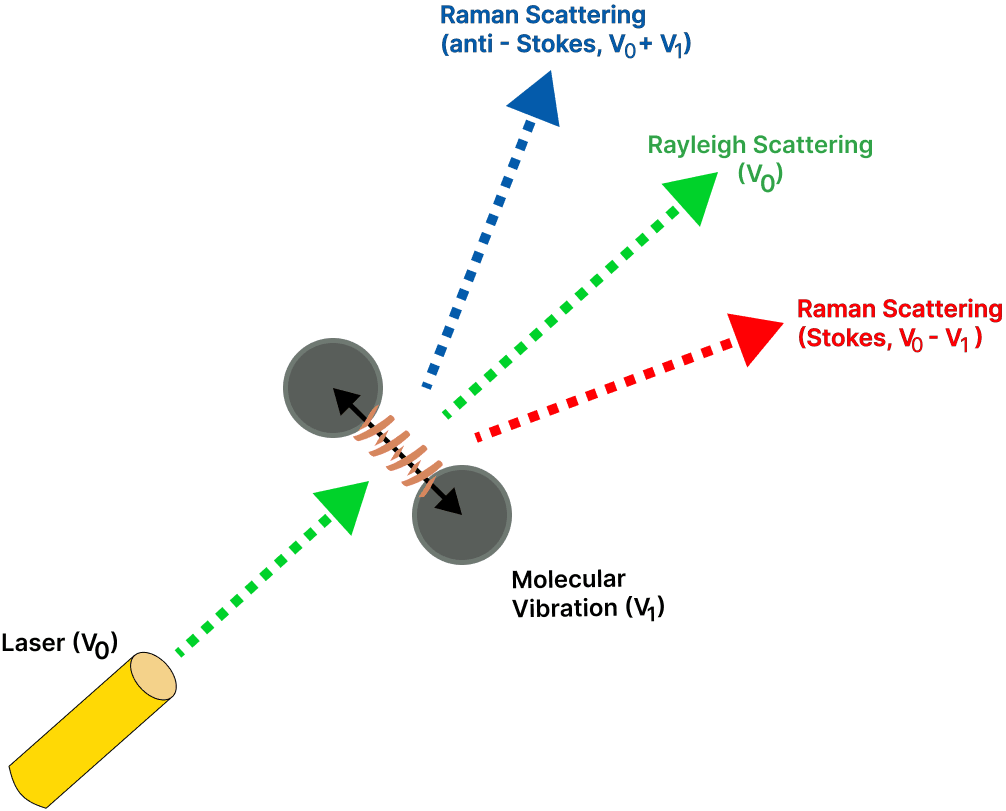 |
With Raman spectroscopy, you can determine:
- Chemical identity
- Molecular structure
- Phase and crystallinity
- Stress and strain
- Impurities and contamination
Since every molecule produces its own distinctive signal, Raman spectroscopy essentially gives you a chemical fingerprint of your sample.
What is Raman Effect & Raman Scattering?
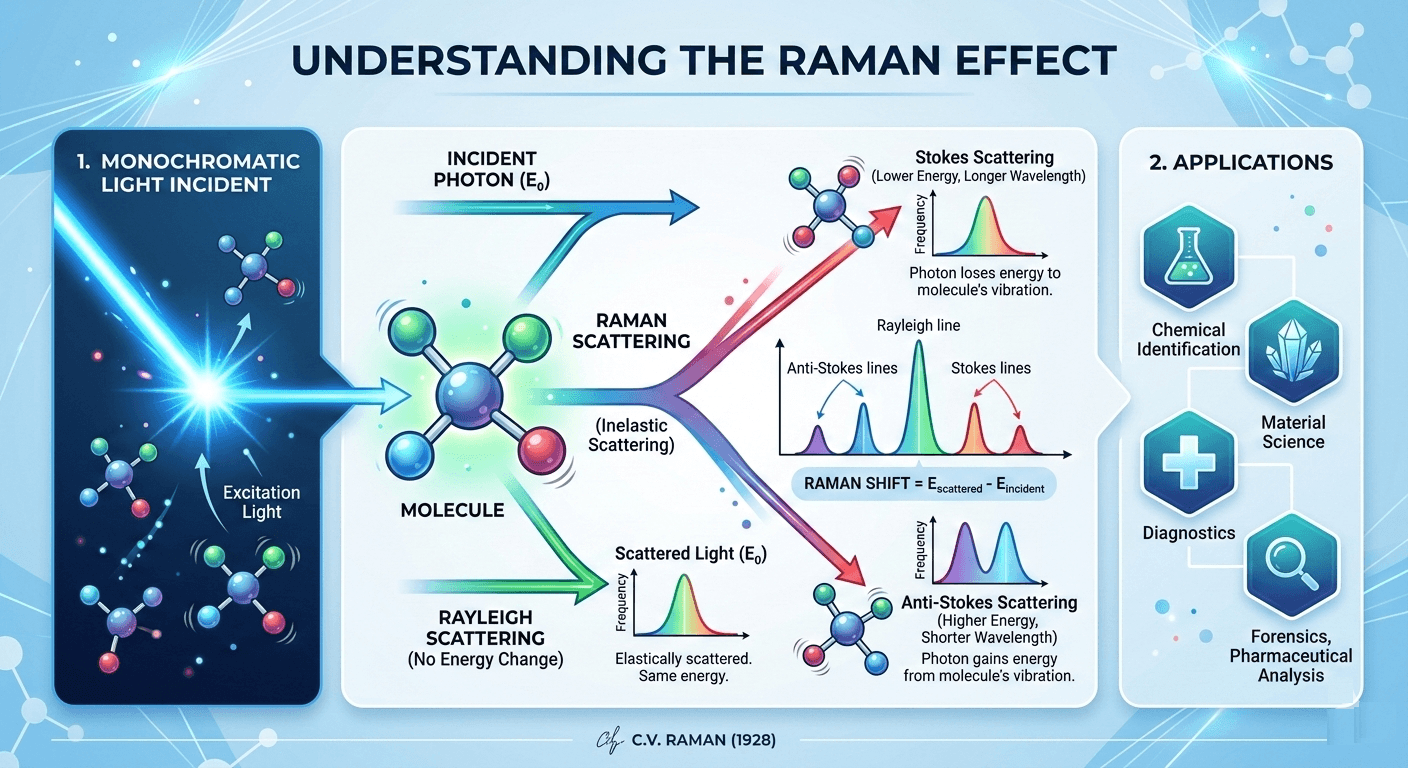
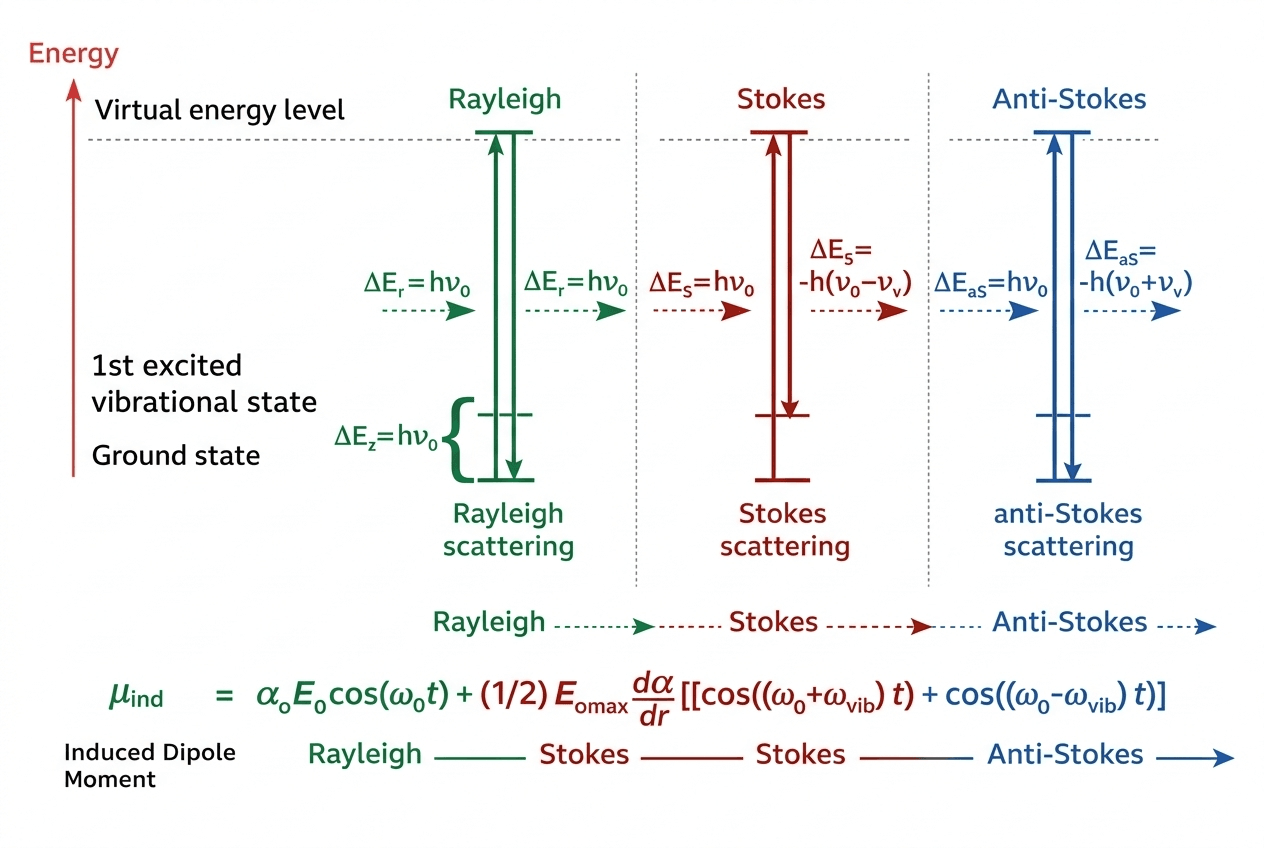
The Raman effect, discovered by Sir C.V. Raman in 1928, is the inelastic scattering of a photon (light particle). This phenomenon occurs when a beam of light interacts with the chemical bonds of a sample, causing a change in the light's energy, which can be measured as a change in frequency or wavelength.
How it Works (A Simple Explanation):
1. Light Source: A high-intensity monochromatic light source, typically a laser, is focused on a sample.
2. Scattering: Most of the light passing through the sample scatters, and its energy remains unchanged. This is called Rayleigh scattering.
3. Inelastic Scattering: A tiny fraction of the light, about one photon in ten million, scatters and exchanges energy with the molecules of the sample.
The scattered photon either loses energy to the molecule, becoming red-shifted (lower frequency, longer wavelength, Stokes Raman scattering), or gains energy from the molecule, becoming blue-shifted (higher frequency, shorter wavelength, Anti-Stokes Raman scattering).
Explore Our Powerful Raman Spectroscopy Solutions »»
How is Raman Spectrometer Constructed?
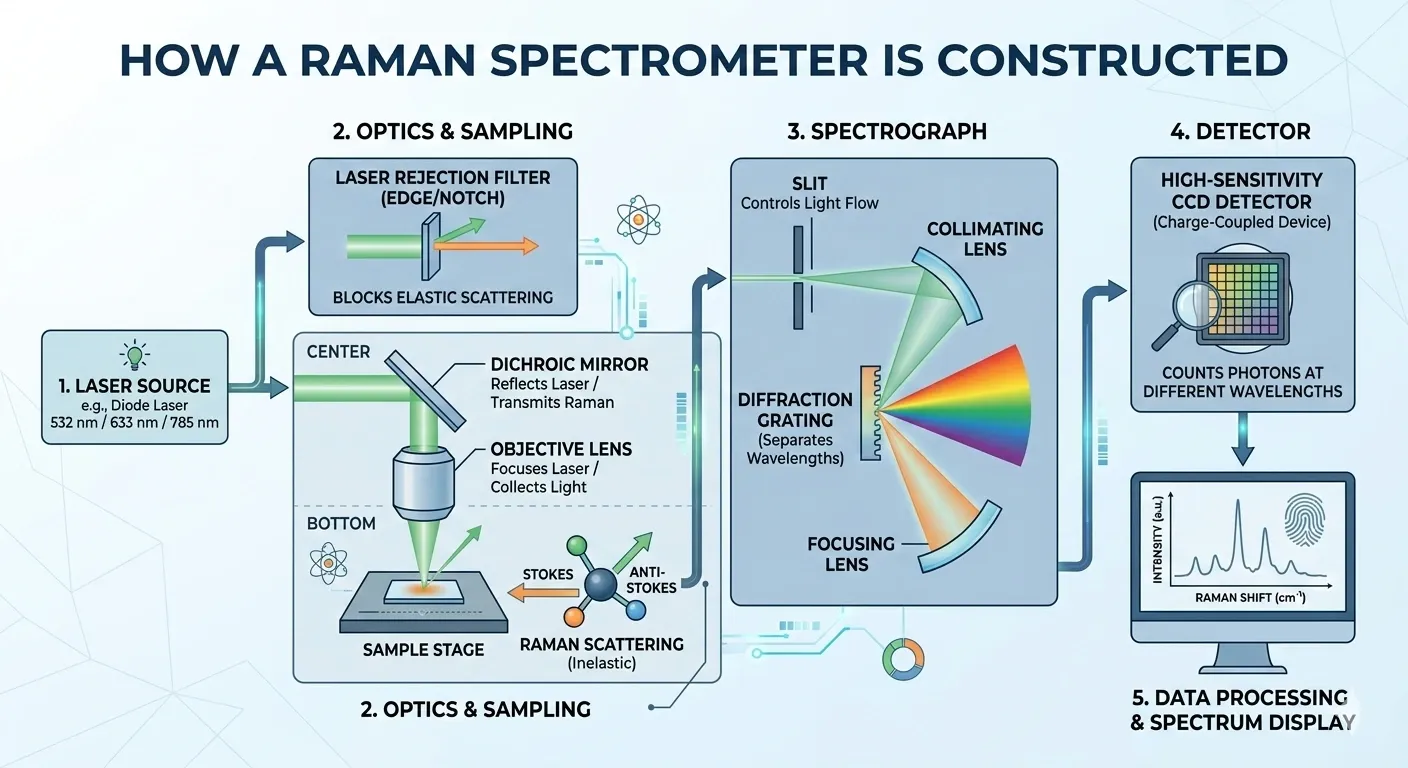
A Raman spectrometer is an instrument used to observe vibrational, rotational, and other low-frequency modes in a system. It works by illuminating a sample with a monochromatic light source (usually a laser) and measuring the scattered light. While most of the light scatters elastically (Rayleigh scattering), a very small fraction scatters inelastically (Raman scattering), meaning its frequency is shifted up or down depending on the vibrational modes of the molecule. This "Raman shift" provides a "fingerprint" that is unique to the molecular structure.
Instrumentation:
1. Laser Source: This is the heart of the system, providing intense, monochromatic light. Common lasers operate at wavelengths like 532 nm (green), 633 nm (red), or 785 nm (near-infrared). The choice depends on the sample type and potential fluorescence.
2. Sampling Optics: This system focuses the laser onto the sample and collects the scattered light. In micro-Raman, an objective lens performs both functions. In macro-Raman, separate lenses or fiber optic probes might be used.
3. Filters (Rejection and Edge): These are critical. A powerful "notch" or "edge" filter must be used to block the extremely bright Rayleigh scattering (at the laser wavelength) from reaching the detector, allowing only the much weaker Raman signals to pass.
4. Spectrograph/ Monochromator: This component disperses the collected and filtered scattered light into its constituent wavelengths. High-resolution systems often use one or more diffraction gratings to achieve this.
5. Detector: A sensitive detector, such as a Charge-Coupled Device (CCD) array, counts the photons at each dispersed wavelength. In advanced systems, deep-depletion or thermoelectrically-cooled CCDs are used to reduce noise.
6. Computer and Software: These convert the raw detector signal into a spectrum (intensity vs. Raman shift in cm⁻¹) for display, analysis, and data storage.
How to read Raman Spectrum?
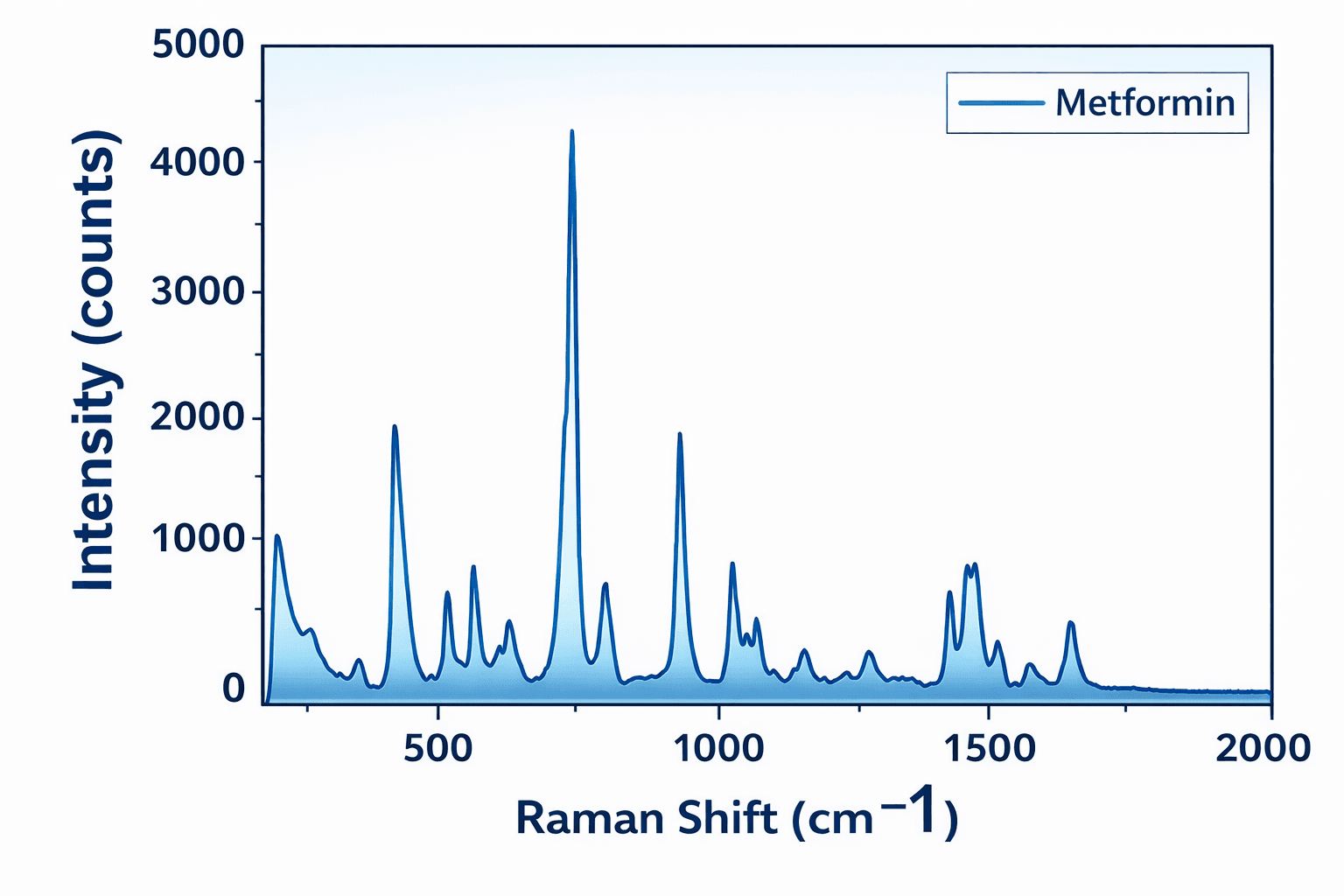
1. Identify the X-Axis: Raman Shift (cm-1)
The horizontal axis represents the Raman Shift, measured in wavenumbers (cm-1). This is not the absolute wavelength of light, but the difference in energy between the incident laser and the scattered light.
- Low shifts (0–1500 cm-1): Usually correspond to heavy atom vibrations or "fingerprint" regions.
- High shifts (2500–4000 cm-1): Usually correspond to light atom vibrations, like C-H or O-H bonds.
2. Observe the Y-Axis: Intensity (Counts)
The vertical axis shows the Intensity. A higher peak means that more photons were detected at that specific energy shift. This tells about the concentration of the substance or the "polarizability" of the chemical bond (how easily its electron cloud deforms).
3. Analyze Peak Positions and Shapes
- Position: Tells what chemical bond is present (e.g., a peak at ~1600 cm-1 often indicates a C=C double bond).
- Width: Narrow peaks suggest a crystalline, well-ordered structure; broad peaks often indicate an amorphous or disordered material.
- Shifts: If a known peak moves slightly to the left or right, it can indicate internal stress, strain, or temperature changes in the material.
 |  |
Industrial Applications of Raman Spectroscopy:
Raman spectroscopy is a powerful analytical technique used across diverse industries to identify chemical composition, molecular structure, and materials properties without damaging the sample (non-destructive analysis).
1. Pharmaceutical Manufacturing (Real-time Analysis): Raman spectroscopy enables non-invasive, real-time monitoring of critical process parameters during drug production. By analyzing chemical shifts, manufacturers can ensure product consistency, identity raw materials, and detect polymorph changes on-line, ensuring batch quality and compliance. Know more about the Raman Pharmaceutical Application.
2. Chemical Industry (Process Control): Integrated directly into production lines, Raman probes provide continuous chemical identification, concentration measurement, and reaction monitoring. This real-time feedback loop allows chemical plants to optimize yields, prevent reactor overshoots, and ensure product purity without stopping the process for sampling.
3. Material Science (Carbon & Thin Film Analysis): Raman is indispensable for characterizing advanced materials. It is the gold-standard for analyzing carbon nanostructures (graphene, carbon nanotubes) and thin films (diamond-like carbon), determining strain, defect density, doping levels, and layer thickness with high precision. It use to Critical Minerals and Rare Earth Elements Analysis
4. Food Safety & Quality Control (Adulterant Detection): Raman spectroscopy is a fast, robust tool for identifying contaminants and verifying food authenticity. It can detect trace adulterants (e.g., melamine in milk, pesticide residues) and analyze oil composition or meat quality through the packaging, without destroying the product.
5. Semiconductor Industry (Stress Mapping & Defect Analysis): Used at critical fabrication stages, Raman provides sub-micron resolution maps of silicon crystalline stress, defect locations, and composition of compound semiconductors (SiC, GaN). This ensures the electrical reliability and yield of modern microchips.
Conclusion -
Raman spectroscopy has become a cornerstone analytical technology across research, industry, and quality control. By harnessing the Raman effect and Raman scattering, scientists obtain a Raman spectrum essentially a molecular fingerprint that reveals chemical composition and structure.
Today's advanced tools, including the Raman microscope, confocal microscope, Raman spectrophotometer, and imaging spectrometer, have made Raman imaging and high-resolution material analysis at micro and nano scales a reality.
As industries continue pushing into nanotechnology, pharmaceuticals, energy materials, and semiconductors, Raman spectroscopy applications will only grow more important. It's already one of the most crucial characterization techniques in modern science, and that position looks secure for years to come.
Related Products
Request for Information
Do you have any questions or requests? Use this form to contact our team.