Raman Spectroscopy for Critical Minerals and Rare Earth Elements (REEs): Copper (Cu)
Advancing Mineral Detection with TechnoS Instruments
Copper (Cu) is a critical industrial and strategic metal essential for electrical infrastructure, renewable energy systems, electric vehicles, power transmission, and electronics. With increasing global electrification and decarbonisation efforts, demand for copper continues to rise, necessitating efficient mineral exploration and accurate identification methods.
Copper occurs in nature in various mineral forms, including carbonates, silicates, sulphides, and oxides. Reliable identification of copper-bearing minerals is vital for geological mapping, resource evaluation, and beneficiation planning.
Raman Spectroscopy has emerged as an effective analytical technique for copper mineral identification due to its ability to probe molecular and lattice vibrations that are highly specific to mineral structure. | 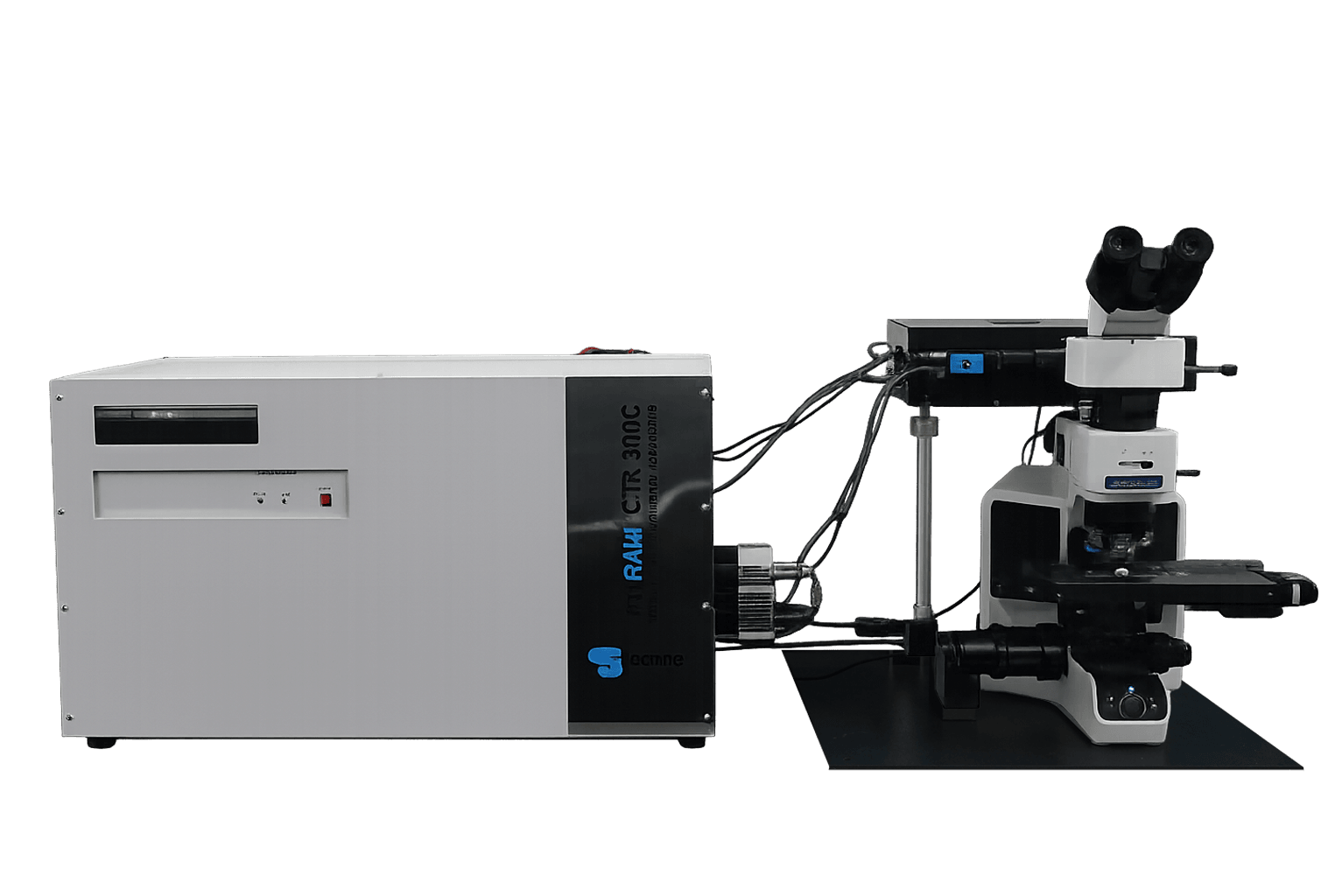 |
Materials & Methods
Raman spectra were acquired using the TechnoS IndiRAM™ CTR Raman spectrometer, designed to provide high spectral resolution, wavelength stability, and excellent signal-to-noise performance for mineralogical analysis.
Samples
Two structurally distinct copper-bearing minerals were Analyses:
- Dioptase – Cu₆Si₆O₁₈·6H₂O (hydrated copper cyclosilicate).
- Malachite – Cu₂CO₃(OH)₂ (basic copper carbonate)
These minerals were selected due to their contrasting silicate and carbonate frameworks.
Results & Discussion
Dioptase Dioptase exhibits Raman features dominated by silicate ring vibrations:
These sharp and well-defined peaks reflect the ordered cyclosilicate structure of Dioptase.
Malachite Malachite displays Raman signatures characteristic of carbonate minerals:
| 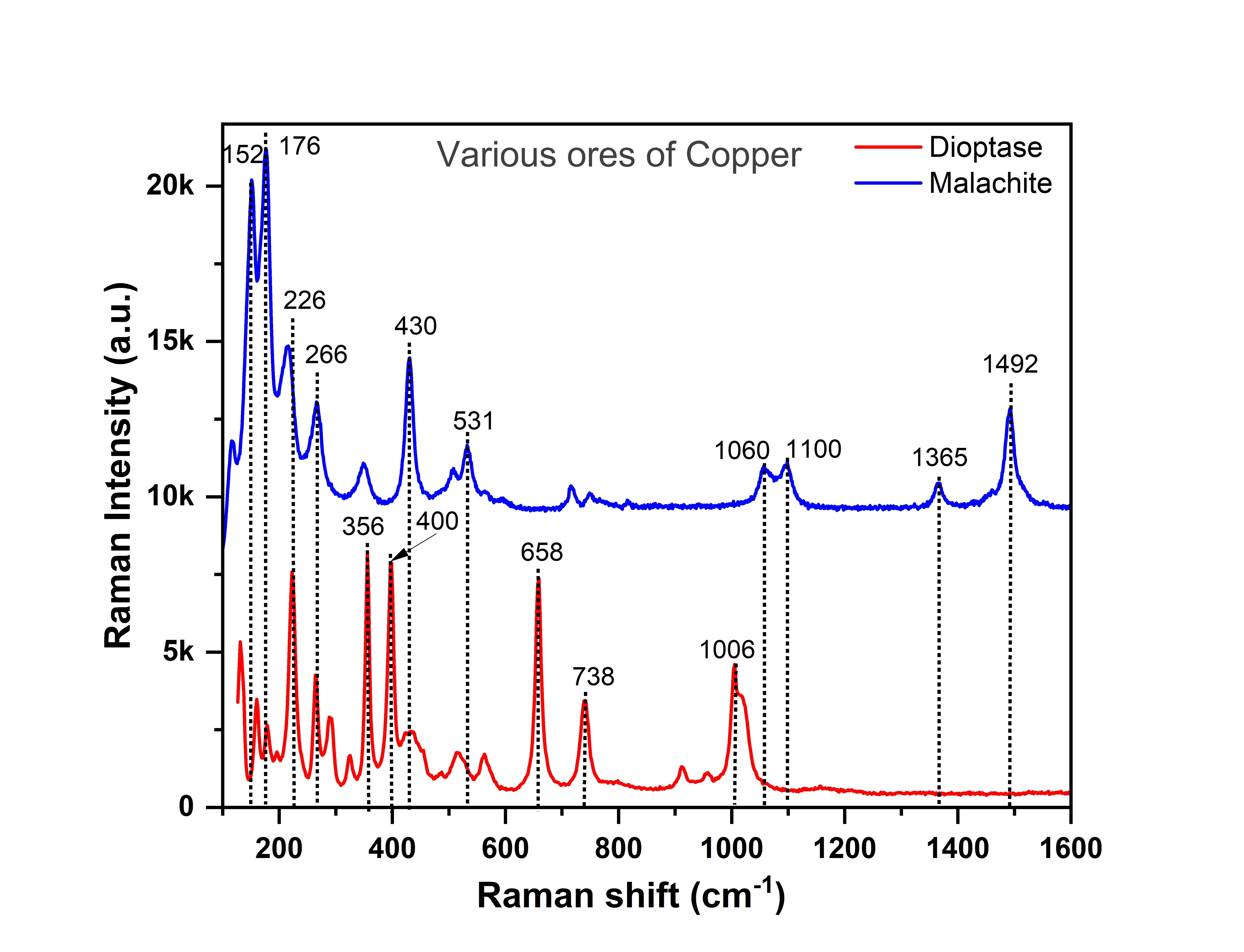 |
- Asymmetric bending near 817–820 cm⁻¹
- Symmetric stretching near 1059 and 1097 cm⁻¹
- Asymmetric stretching modes around 1368–1490 cm⁻¹
The dominance of carbonate-related bands clearly differentiates Malachite from silicate-based copper minerals.
Mineral Discrimination
Despite visual similarity, Dioptase and Malachite show distinct and non-overlapping Raman fingerprints, enabling rapid and confident mineral identification without sample preparation.
Conclusion
Raman spectroscopy provides a fast, non-destructive, and highly specific method for identifying copper-bearing minerals. The distinct spectral signatures of Dioptase (silicate) and Malachite (carbonate) demonstrate Raman’s effectiveness for copper mineral discrimination in exploration and processing environments.
Using high-resolution Raman systems and with ongoing development of Portable Raman solutions, TechnoS Instruments enables accurate, field-ready mineral identification to support the growing demand for critical minerals such as copper.
References
Rinaudo, C., Gastaldi, D., & Croce, G. Raman characterization of lithium aluminosilicates. Journal of Raman Spectroscopy, 36, 810–816 (2005).
- Frost, R.L., et al. Raman spectroscopy of carbonate minerals. Spectrochimica Acta Part A, 67, 604–611 (2007).
- McMillan, P.F. Vibrational spectroscopy of silicates. Physics and Chemistry of Minerals, 16, 245–254 (1988).
- Data taken at IIGJ-Jaipur using IndiRAM CTR-300C Raman Spectrometer system.