
IndiRAM™ High-Resolution Confocal Raman Spectrometer
IndiRAM™ Confocal Raman Spectrometer
India’s first Make-in-India high-resolution confocal Raman spectrometer, the TechnoS IndiRAM™ CTR Series Raman Spectrometer, is built for research laboratories, quality-control teams, and industrial analytical facilities that require high spectral resolution, sensitivity, and flexible system configuration. With spectral resolution below (<1 cm⁻¹), confocal optics, high-sensitivity detection, and configurable laser options, the IndiRAM™ supports demanding Raman analysis across pharmaceuticals, material science, critical minerals, batteries, diamonds, chemicals, and other advanced applications. Developed by TechnoS Instruments in collaboration with CSIR-AMPRI, Bhopal, under the Government of India’s NMITLI programme, the CTR Series provides a research-grade Raman spectroscopy platform manufactured and supported in India. Its modular architecture can be configured around specific analytical requirements, including Raman microscopy, imaging, and remote-probe measurements.
Product Features
Compact & Flexible System Configuration
High Resolution: < 0.3 - 1 cm⁻¹
Measurement down to 10 cm⁻¹ using specialised filters
Confocal Optics for Microscope and Remote Probe Applications.
Fully automated 2D and 3D Raman imaging.
- Compatible with advanced analytical techniques and instruments such as AFM, XRD, and SEM.
- Modular architecture and customised solutions, including UV–Vis–NIR configurations.
Areas of Application

Pharmaceuticals & Nutraceuticals

Life Sciences & Medical Diagnostics

Forensic Science & Narcotics Analysis

Composite Materials & Thin Flims

Pesticides & Agricultural Industries

Chemicals & Petrochemicals

Food Adulteration Studies: Milk, Ghee & Oils

Materials Science, 2D Materials, Batteries & Diamonds
Request for Information
Do you have any questions or requests? Use this form to contact our team.
Related Products

Application Note
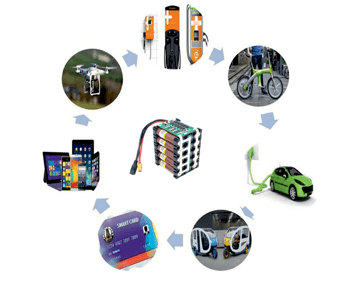
Battery Material Analysis
A fundamental understanding of battery materials and their characterisation is essential for advancing energy-storage technologies and improving battery performance.
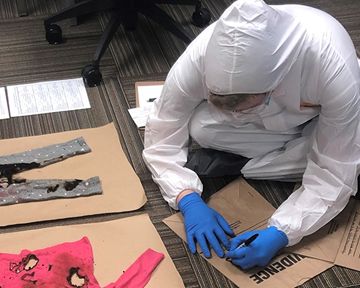
Tracer Forensic Analysis
Raman Spectroscopy has found applications in diverse fields of forensic science, such as toxicology, trace analysis, drug detection, and document authentication.

Pharmaceutical API / RMID
The quality of pharmaceutical products depends on the consistency and uniformity of active pharmaceutical ingredients (APIs) and excipients.
Raman Spectrometer or Confocal Raman Microscope
Raman spectroscopy measures small energy shifts in scattered light. Each shift matches a molecular vibration, so the spectrum works as a fingerprint for identifying materials.
In the IndiRAM™ Raman Spectrometer, laser light is focused through a microscope objective. The scattered light passes a confocal aperture into an imaging spectrometer and a TE-cooled CCD. The aperture rejects out-of-focus light, so each spectrum comes from a small, defined volume. You get cleaner data from thin layers, single particles and inclusions, plus depth profiling in transparent samples. Use it as a confocal Raman microscope for micro-scale samples, or switch to the remote probe when a sample cannot go under the microscope. With the automated stage, 2D and 3D maps show how composition, phase, crystallinity and stress are distributed. Compatibility with AFM, XRD and SEM links those maps to topography and structure.
Why Researchers Choose the IndiRAM Raman Spectrometer?
High resolution for confident spectral identification
With spectral resolution better than 1 cm⁻¹, the IndiRAM Raman Spectrometer helps resolve closely spaced Raman bands that can be difficult to distinguish. This enables researchers to identify API polymorphs, investigate strain-related spectral shifts in thin films, and differentiate mineral phases with similar Raman signatures.
Confocal Raman Optics for Precise Micro-Analysis
Confocal optics help suppress out-of-focus signals, allowing researchers to focus on the particle, inclusion, surface, or layer of interest rather than surrounding material. Use the integrated Raman microscope for microscopic samples and detailed measurements, or switch to a remote Raman probe when the sample cannot be brought directly to the instrument.
Turn Raman Spectra into Chemical Images
Go beyond individual spectra with automated 2D and 3D Raman imaging. The IndiRAM Raman Spectrometer can create chemical maps that reveal the spatial distribution of materials for example, identifying where an API is distributed within a tablet, examining dopant distribution, or visualising multiple layers within a coating.
Explore Low-Frequency Raman Signals
With specialised optical filters, the system can measure Raman signals down to 10 cm⁻¹. Low-frequency Raman spectroscopy provides valuable information for studying lattice vibrations, crystal phases, polymorphism, and 2D materials, expanding the range of research applications available from a single platform.
Select the Raman Laser for Your Application
Choose from 375, 405, 532, 638, 785, and 1064 nm excitation wavelengths, with additional wavelength options available on request. Its modular UV–Vis–NIR architecture allows the Raman instrument to be configured around your sample and application requirements, with flexibility for future expansion.
Integrate Raman with Your Existing Research Workflow
The IndiRAM Confocal Raman Spectrometer can complement other analytical techniques, including AFM, XRD, and SEM. Combining Raman chemical information with structural, morphological, and surface characterisation gives researchers a more comprehensive understanding of their materials without treating Raman analysis as a standalone technique.
Make in India Without Compromising on Performance
Buying an imported confocal Raman spectrometer usually means long waits, payment in foreign currency, and slow support when something goes wrong. The IndiRAM™ Raman instrument changes that. It's a research-grade Raman spectrometer built and supported entirely in India.
The Raman Spectrometer is made for serious research and industrial work. It delivers high spectral resolution, strong sensitivity, and flexible configurations, plus the ease of local manufacturing and support. That means faster service, easier access to spares, and a Raman spectroscopy platform you can shape around your own lab's needs, not a fixed import spec sheet.