
Raman Spectroscopy for Mica Minerals (Muscovite & Lepidolite)
Critical Minerals and Rare Earth Element : Mica Minerals
Mica minerals are layered Aluminosilicates widely used in electrical insulation, electronics, polymers, and coatings. Certain mica varieties, particularly Lepidolite, are also important as lithium-bearing minerals, making them relevant to critical mineral exploration and energy storage technologies.
Muscovite is a potassium-rich mica commonly found in granitic and metamorphic rocks, whereas Lepidolite is a lithium-rich mica associated with pegmatite lithium deposits. Due to their similar appearance and layered structures, rapid and reliable differentiation of these minerals is essential for geological mapping and lithium resource assessment.
Raman spectroscopy provides a fast, non-destructive technique for mica identification by probing vibrational modes that are highly sensitive to compositional and structural differences within the mica lattice.
Materials & Methods
Raman spectra were acquired using the TechnoS IndiRAM™ CTR Raman Spectrometer, offering high spectral resolution, wavelength stability, and excellent signal-to-noise performance for mineralogical analysis. The following mica minerals were analyses:
- Muscovite – KAl₂(AlSi₃O₁₀)(OH)₂
Lepidolite – K(Li,Al)₃(Al,Si)₄O₁₀(F,OH)₂
Results & Discussion
Muscovite
Muscovite exhibits Raman features characteristic of potassium-rich mica, including lattice vibrations below ~300 cm⁻¹, Si–O–Al bending modes in the ~400–450 cm⁻¹ region, and a strong Si–O stretching band near ~700 cm⁻¹. These bands reflect its ordered layered silicate structure.
Lepidolite
Lepidolite shows Raman signatures influenced by lithium substitution, with modified lattice modes below ~300 cm⁻¹, differences in the ~250–300 cm⁻¹ region compared to Muscovite, and additional features in the ~1000–1150 cm⁻¹ range related to internal tetrahedral vibrations affected by Li and F content. These spectral differences allow clear discrimination between lithium-bearing and non-lithium mica minerals. | 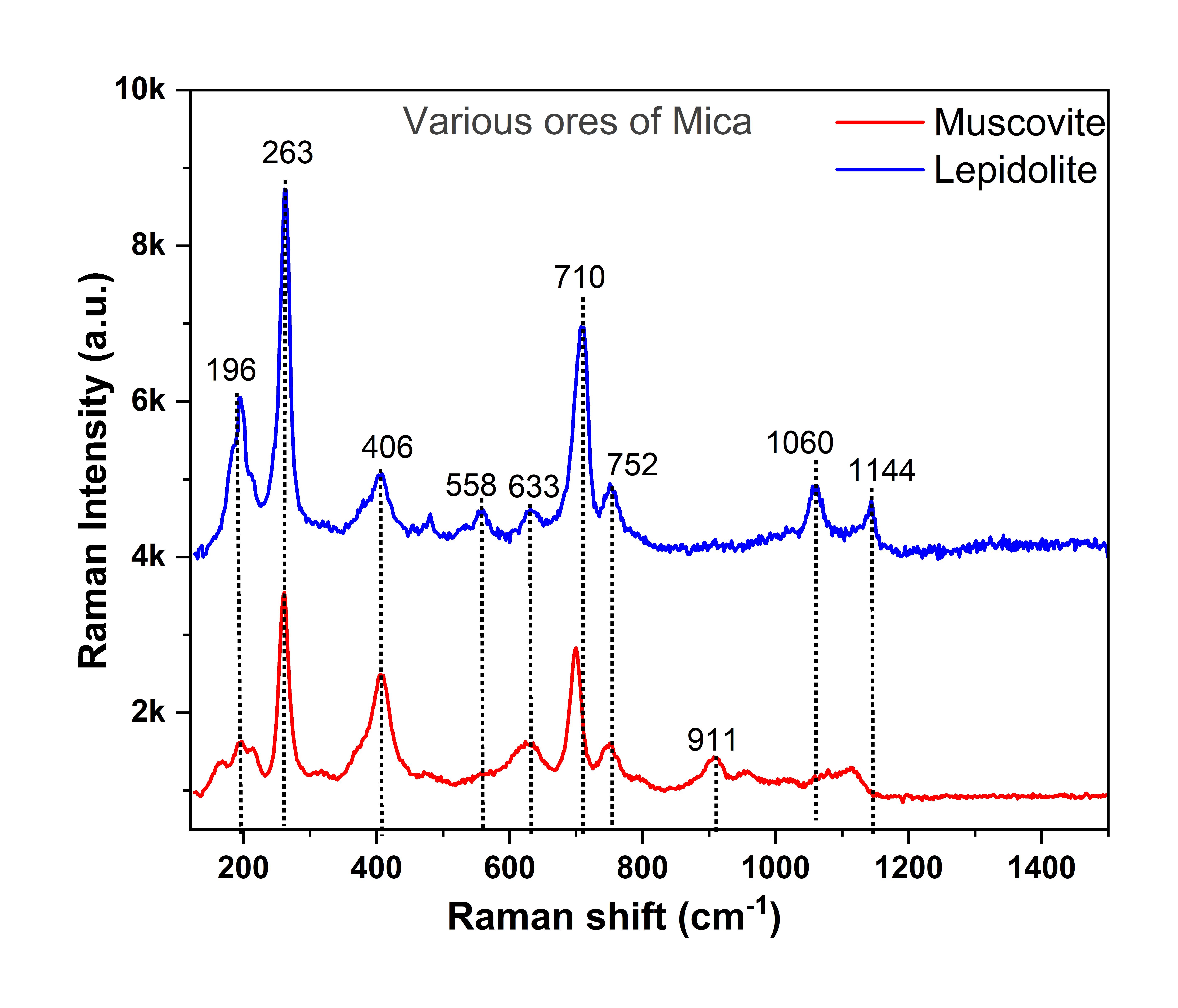 |
Conclusion
Raman Spectroscopy enables rapid, non-destructive identification of mica minerals. The distinct Raman signatures of Muscovite and Lepidolite allow confident differentiation of lithium-bearing mica from potassium-rich mica without sample preparation.
With high-resolution laboratory systems and ongoing development of Portable Raman Spectrometers, TechnoS Instruments provides effective solutions for mica characterization, lithium exploration, and critical mineral analysis.
References
McMillan, P.F. Vibrational spectroscopy of silicates. Physics and Chemistry of Minerals, 16, 245–254 (1988).
- Reddy, B.J., Frost, R.L., et al. Raman spectroscopy of mica minerals. Spectrochimica Acta Part A, 78, 1201–1206 (2011).
- Nasdala, L., et al. Raman spectroscopy in mineralogy. European Journal of Mineralogy, 16, 809–821 (2004).
- Data taken at IIGJ-Jaipur using IndiRAM CTR-300C Raman Spectrometer system.