Revolutionizing Cancer Detection: How Raman Spectroscopy is Changing Early Diagnosis
Revolutionizing Cancer Detection: How Raman Spectroscopy is Changing Early Diagnosis
April 16, 2025
Introduction
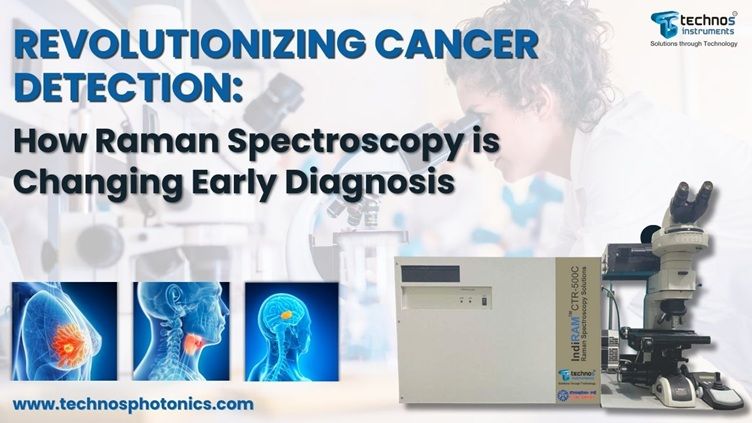
Early cancer detection is a crucial factor in improving patient survival rates. Traditional diagnostic techniques such as imaging, CT, MRI, Mammography and biopsies, while effective, have limitations like invasiveness, false negatives, and high costs. Most of all, they are either not very effective or are very costly, in early detection of cancer. There is growing need for a non-invasive, rapid, and highly accurate diagnostic method.
Raman Spectroscopy is emerging as a powerful tool for cancer diagnosis. This label-free, non-destructive technique analyses light interaction with molecular structures, generating a "molecular fingerprint" unique to different biological samples. Researchers are increasingly exploring its potential for cancer screening, early cancer detection, diagnosis, and even intraoperative guidance.
Understanding Raman Spectroscopy - Raman Spectroscopy is based on the principle of Raman scattering, an inelastic scattering of light. When a monochromatic laser interacts with a sample, most light is elastically scattered (Rayleigh scattering), but a small fraction undergoes Raman scattering. This shift in energy provides molecular vibrational information, which is analysed to identify chemical compositions.
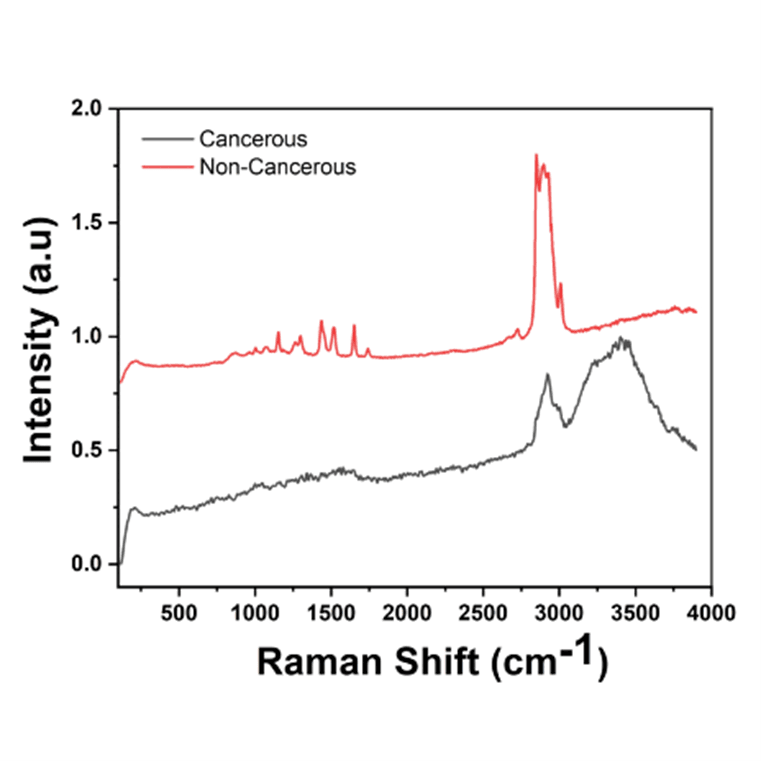
Application of Raman Spectroscopy in Cancer Detection - Cancer development leads to changes in biomolecular structures like proteins, lipids, and nucleic acids in a cell. Raman Spectroscopy can detect these changes, distinguishing between normal and cancerous cells and tissues with high accuracy.
Applications of Raman Spectroscopy in cancer diagnosis include
In Vitro Detection: Differentiates normal and cancerous cells using spectral signatures in a laboratory.
In Vivo Detection: Fibre-optic probes enable real-time diagnosis on live tissue in various organs like the brain, breast, cervix, lungs, and bladder.
Liquid Biopsy: Detects circulating tumour cells and biomarkers in fluids like blood, urine, and saliva.
Several studies highlight its success in detecting brain, breast, gastric, ovarian, prostate, and lung cancers. For instance, Raman Spectroscopy has achieved high accuracy in distinguishing breast cancer from benign tumours and normal tissue through blood serum analysis.
Advantages of Raman Spectroscopy over Conventional Methods
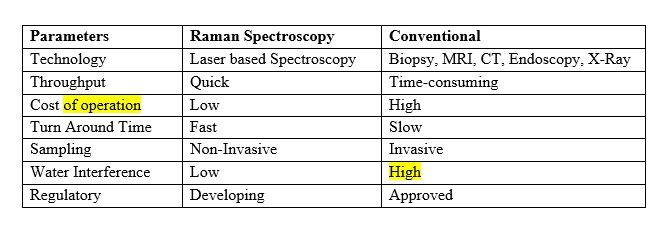
Raman Spectroscopy offers several benefits compared to traditional cancer detection techniques:
Non-Invasive: No need for tissue removal or contrast agents, reducing patient discomfort.
High Sensitivity & Specificity: Identifies cancerous tissues with superior accuracy.
Real-Time Analysis: Enables rapid decision-making in surgical settings.
Minimal Sample Preparation: Unlike other molecular techniques, Raman Spectroscopy requires little to no sample preparation and/or processing.
Challenges and Limitations
Despite its advantages, the widespread adoption of Raman Spectroscopy faces some challenges:
- Weak Signal: Only a tiny fraction of scattered light undergoes Raman scattering, requiring high-powered lasers and sensitive detectors.
- Fluorescence Interference: Biological samples often produce fluorescence, overshadowing Raman signals.
- Standardization Issues: The lack of universal spectral databases and protocols affects reproducibility across research groups.
- High Cost: Advanced Raman systems and maintenance costs may limit accessibility, especially in resource-limited settings.
Researchers are addressing these challenges by developing techniques like Surface-Enhanced Raman Spectroscopy (SERS) to amplify weak signals and using machine learning for more precise spectral interpretation. Using a laser and detector specific to cancer detection, can also help reduce the cost of the system.
Case Studies & Advancements in cancer diagnostics with Raman technology
Several successful applications demonstrate Raman Spectroscopy’s potential:
Breast Cancer Diagnosis: Serum analysis using Raman Spectroscopy combined with machine learning achieved up to 98% accuracy.
Cervical Cancer Detection: A large-scale study achieved a classification accuracy of 91.3%.
Brain Tumour Resection: Raman-integrated biopsy needles enable real-time identification of malignant tissue, improving surgical precision.
Ongoing research focuses on improving Raman Spectroscopy’s clinical applications, including:
Portable Raman Devices: Handheld spectrometers for point-of-care diagnostics.
Integration with Imaging Technologies: Combining Raman with endoscopy or microscopy enhances multi-modal cancer detection.
AI and Machine Learning: Advanced algorithms analyse spectral data for automated, accurate cancer classification.
Future Impact
The future of Raman Spectroscopy in oncology looks promising. Potential applications include:
- Non-Invasive Population-Wide Screening: Liquid biopsy-based Raman tests for early cancer detection.
- Guiding Minimally Invasive Interventions: Real-time feedback during surgeries for improved tumour margin assessment.
- Personalized Medicine: Molecular fingerprinting aids in tailoring treatments for individual patients.
However, ethical and regulatory considerations must be addressed. Patient data privacy, algorithmic biases in AI-driven diagnosis, and over-diagnosis risks require careful management. Regulatory approval through extensive clinical trials and standardization efforts will be crucial for integrating Raman Spectroscopy into mainstream healthcare.
Why is Raman Spectroscopy a game-changer?
Conclusion
Raman Spectroscopy is poised to revolutionize early cancer detection, offering a non-invasive, highly accurate alternative to traditional methods. While challenges remain, advancements in signal enhancement, AI-driven analysis, and portable devices are paving the way for its clinical adoption. With continued research and regulatory efforts, Raman Spectroscopy has the potential to transform cancer diagnostics, enabling early detection and ultimately saving lives.
Related Articles
- Raman Spectroscopy for Illicit Drug Detection
- Quartz Identification Using Raman Spectroscopy
- Field Testing Simplified: Benefits of Portable Raman Spectrometers
- Gemstone Identification with Raman Spectroscopy
- IndiRAM Raman Spectrometer for identification of Excipients in Pharmaceutical Drugs
- Innovations in Raman Spectroscopy: TechnoS at the Forefront
- Microplastic Contamination Detection in Food Grains: A Raman Spectroscopy Approach
- Powering the Future: How Raman Spectroscopy is Advancing Battery Material Analysis
- Principle of Raman Spectroscopy & Core Components
- Raman Spectroscopy: A Transformative Tool Across Science, Industry, and Society