Real-Time Explosive Trace Detection with IndiRAM Raman Spectrometer
Real-Time Explosive Trace Detection with IndiRAM Raman Spectrometer
May 17, 2025

Introduction: Why Rapid Explosive Trace Detection Matters - A Critical Need for India
Frequent IED-related incidents in high-risk regions of India highlight the urgent need for real-time explosive trace detection. As the country navigates evolving security challenges across both urban and border areas, rapid identification of hazardous materials is crucial. Raman spectroscopy, particularly through the IndiRAM portable series by TechnoS Instruments India, offers a fast, non-contact solution for identifying explosives. Designed for defence, forensic, and law enforcement use, these tools offer customization options and deliver a technological edge in the fight against terrorism and organized threats.
What Is Raman Spectroscopy?
Raman spectroscopy identifies substances based on the unique vibrational energy of molecular bonds. When a laser beam interacts with a material, it scatters light in patterns that can be captured and interpreted as a Raman spectrum - essentially, a chemical fingerprint.
Why Raman for Explosive Detection?
Non-contact and non-destructive
- Works through transparent materials (e.g., glass, plastic)
- Real-time results — often within seconds
- Portable and easy to operate in the field
- No reagents or consumables needed
This makes Raman ideal for detecting explosive traces on-site, whether in suspicious packages, residues from blast sites, or on contaminated surfaces.
Types of Explosives Detected
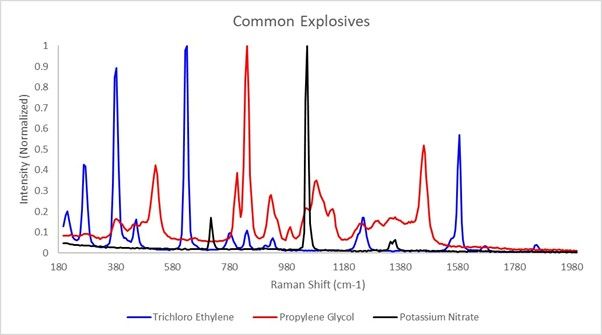
Raman spectroscopy can identify a wide range of chemical explosives based on their molecular structures. The IndiRAM series supports on-board spectral libraries or integration with external databases for substance matching.
Common Explosive Types by Chemical Class:
1. Nitroaromatics: Such as TNT (Trinitrotoluene), DNT
2. Acid Salts: Including Ammonium Nitrate (a common IDE component)
3. Organic Peroxides: Like TATP (Triacetone Triperoxide) and HMTD
4. Nitrate Esters: Such as Nitroglycerin, EGDN (Ethylene Glycol Dinitrate)
5. Nitramines: Including RDX (Research Department Explosive), HMX (High Melting Explosive), Tetryl
6. Other types: Black Powder, smokeless powders, and precursors
These compounds have distinct Raman spectra, enabling rapid, reliable field identification - even in trace quantities.
Meet the IndiRAM Series by TechnoS Instruments
The IndiRAM series from TechnoS Instruments includes several portable Raman spectrometers designed for real-time hazardous material detection, including explosives. These instruments are tailored for rugged, high-pressure environments like:
- Border security and customs
- Counter-terrorism units
- Forensic crime scene investigations
- Bomb disposal squads
- Infrastructure protection (airports, railways, and metro systems)
Models Suitable for Explosive Trace Detection:
IndiRAM P785_Tracer – High sensitivity at 785 nm for a wide range of organic explosives
IndiRAM P1064_Tracer – Ideal for coloured or fluorescent samples, reducing background


How Real-Time Detection Works
Here’s a step-by-step breakdown of how the IndiRAM Raman system works in practice:
- Sample Scan – Point the device at a surface or swab a residue.
- Laser Excitation – A laser beam (320/375/405/532/633/785/830/1064 nm) excites the molecules.
- Spectral Capture – Scattered light is measured to form a Raman spectrum.
- Identification – The spectrum is compared to a reference library.
Real-Time Result – Identification is displayed within seconds.
Time-to-Result: Typically < 10 seconds
The process is safe, efficient, and doesn’t require a chemistry background to operate - perfect for on-the-go security personnel.
Applications across Security & Forensics
The portability and power of the IndiRAM series make it useful across a wide range of domains:
Advantages of IndiRAM in Explosive Trace Detection
Ultra-fast detection with immediate feedback
Compact, rugged design for fieldwork
High specificity reduces false positives
Spectrum storage and cloud integration for reporting
Safe operation with laser interlocks and user protection
Limitations & Safety Considerations
While Raman is a robust tool, there are a few considerations:
- Fluorescent materials may require 1064 nm lasers to avoid interference.
- Proper handling of laser safety protocols is essential.
- Sample geometry and environmental light can affect results slightly.
Conclusion: A Safer Tomorrow with Smarter Tools
As explosive threats become increasingly frequent and sophisticated, the demand for advanced explosive trace detection technology continues to grow. The IndiRAM series of portable Raman spectrometers provides a game-changing solution for security forces, military personnel, and law enforcement agencies. Designed for rapid, accurate, and field-deployable explosive identification, IndiRAM empowers frontline responders to act with confidence - whether at a crime scene, border checkpoint, or during urban security operations.
By delivering real-time chemical analysis in a compact, rugged device, IndiRAM ensures no trace of danger goes undetected. In the face of rising threats, technologies like IndiRAM are more than just tools - they are essential force multipliers in the fight for national security. For organizations seeking reliable, high-performance explosive detection systems, IndiRAM represents the future of portable Raman spectroscopy in security and defense.
Related Articles
- Gemstone Identification with Raman Spectroscopy
- Field Testing Simplified: Benefits of Portable Raman Spectrometers
- Raman Spectrometer Principle and Core Components
- Raman Spectroscopy for Illicit Drug Detection
- Quartz Identification Using Raman Spectroscopy
- IndiRAM Raman Spectrometer for identification of Excipients in Pharmaceutical Drugs
- Innovations in Raman Spectroscopy: TechnoS at the Forefront
- Microplastic Contamination Detection in Food Grains: A Raman Spectroscopy Approach