Raman Spectroscopy for Critical Minerals and Rare Earth Elements (REEs) – Mica Minerals
Raman Spectroscopy for Critical Minerals and Rare Earth Elements (REEs) – Mica Minerals
January 15, 2026
Introduction: Mica as a Critical and Strategic Mineral Group
Mica minerals are an important class of layered aluminosilicates widely used in electronics, insulation, cosmetics, paints, polymers, and high-temperature applications. Certain mica varieties also play a critical role in battery materials and lithium resources, making them increasingly relevant in the context of critical minerals and energy transition.
Among mica minerals, Muscovite is a potassium-rich mica commonly found in granitic and metamorphic rocks, while Lepidolite is a lithium-bearing mica that serves as a significant secondary lithium resource. Accurate identification and differentiation of these minerals are essential for geological mapping, resource assessment, and beneficiation planning.
Raman spectroscopy provides a rapid and non-destructive method for identifying mica minerals by probing their lattice and molecular vibrational modes, which are highly sensitive to compositional and structural differences.
Why Raman Spectroscopy for Mica Mineral Identification
Traditional mineral identification techniques such as optical microscopy, XRD, and chemical analysis are reliable but often require extensive sample preparation and laboratory infrastructure. Raman spectroscopy offers several advantages:
- Non-destructive and contactless analysis
- Minimal or no sample preparation
- High sensitivity to layered silicate structures
Ability to distinguish visually similar mica minerals
Compatibility with laboratory and portable Raman systems.
These advantages make Raman spectroscopy especially suitable for identifying lithium-bearing mica phases during exploration and processing.
Mica Minerals Studied: Muscovite and Lepidolite
In this study, two structurally similar but compositionally distinct mica minerals were analysed:
- Muscovite – KAl₂(AlSi₃O₁₀)(OH)₂ - A potassium aluminium mica, widely used as an electrical and thermal insulator.
- Lepidolite – K(Li,Al)₃(Al,Si)₄O₁₀(F,OH)₂ - A lithium-rich mica and an important source of lithium.
Despite belonging to the same mica group and sharing a layered silicate structure, Muscovite and Lepidolite exhibit distinct Raman spectral features due to differences in cation composition and bonding environment.
Raman Spectral Analysis of Muscovite and Lepidolite
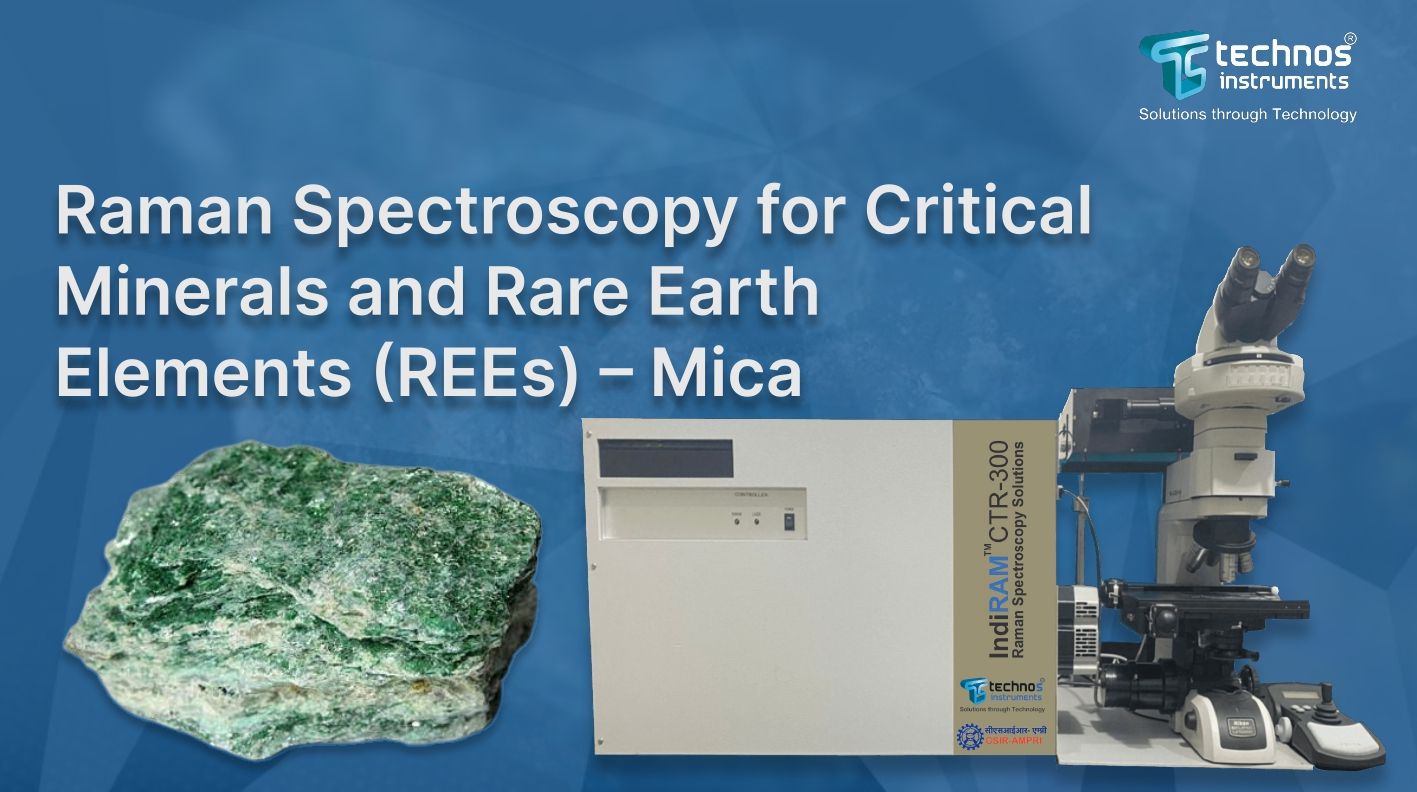
The Raman spectra were acquired using the TechnoS IndiRAM™ CTR Raman spectrometer, covering the spectral range relevant to lattice vibrations and internal silicate modes.
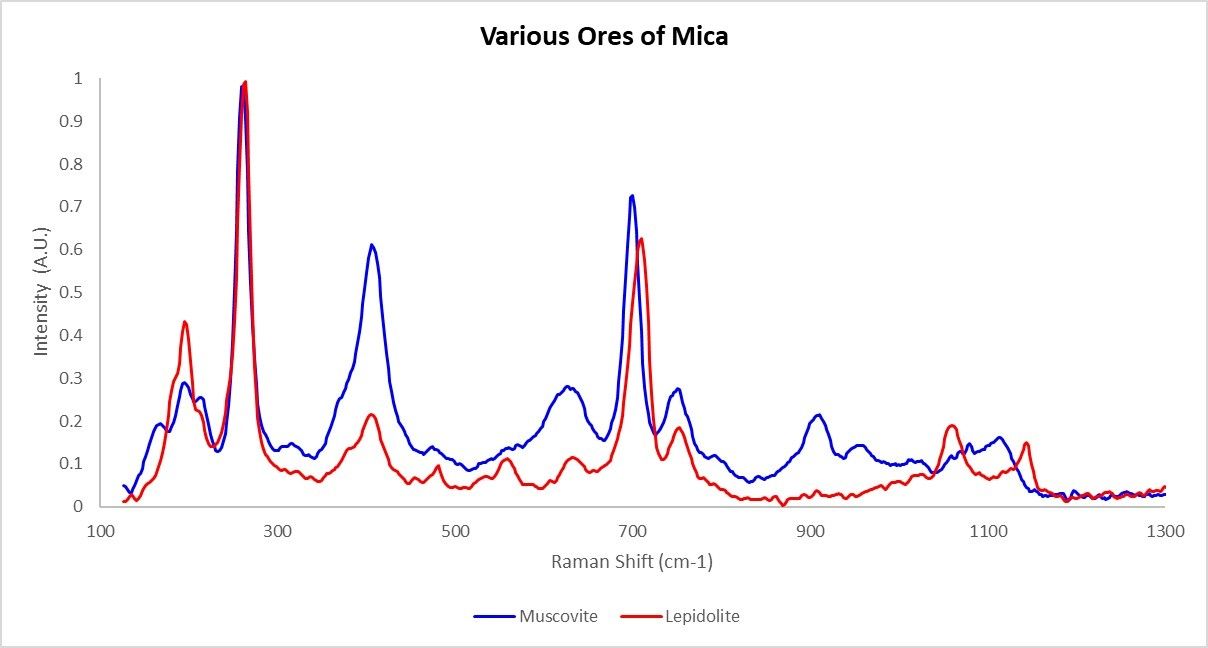
Muscovite (Blue Spectrum)
Muscovite exhibits Raman features characteristic of Potassium-rich Aluminosilicates mica:
- Strong band near ~260–280 cm⁻¹, Lattice modes involving tetrahedral–octahedral sheet coupling and interlayer cation motion (K⁺)
- Intense peak around ~400–450 cm⁻¹, associated with Si–O–Al bending modes
- Prominent band near ~700 cm⁻¹, corresponding to Si–O stretching vibrations within tetrahedral sheets
- Additional weaker features above ~900 cm⁻¹, related to higher-order Si–O stretching modes.
These well-defined peaks reflect the ordered layered structure of Muscovite.
Lepidolite (Red Spectrum)
Lepidolite displays Raman signatures influenced by lithium substitution within the mica lattice:
- Lattice modes below ~300 cm⁻¹, modified by Li–O and Al–O vibrations
- Distinct peak near ~260–300 cm⁻¹, slightly shifted compared to Muscovite due to Li incorporation
- Strong Si–O stretching band near ~700 cm⁻¹, similar in position but differing in intensity and shape
- Additional bands in the ~1000–1150 cm⁻¹ region, associated with internal tetrahedral vibrations influenced by Li and F content
These spectral variations enable clear differentiation between lithium-bearing and non-lithium mica phases.
Key Observations and Mineral Discrimination
Muscovite is identified by its K-rich lattice vibration patterns.
- Lepidolite shows distinct spectral shifts and intensity changes due to lithium substitution.
- Despite structural similarity, the two mica minerals exhibit distinct and reproducible Raman fingerprints.
- Raman spectroscopy enables rapid discrimination of lithium-bearing mica without sample preparation.
This highlights Raman’s effectiveness for mica mineral identification in exploration and processing environments.
TechnoS Instruments: Raman Solutions for Mica and Lithium Exploration
The spectra presented were generated using the high-resolution Raman spectrometer developed by TechnoS Instruments, offering:
- High spectral resolution and wavelength stability
- Excellent signal-to-noise ratio for layered silicates
- Capability to resolve subtle lattice and compositional differences.
Building on laboratory-grade performance, TechnoS Instruments is actively developing a portable Raman spectrometer aimed at on-site identification of mica, lithium-bearing phases, REE-host minerals, and other critical resources, enabling real-time decision-making during geological exploration.
Conclusion
Raman Spectroscopy provides a fast, non-destructive, and highly specific method for identifying mica minerals. The clear spectral differences between Muscovite and Lepidolite demonstrate Raman’s strength in distinguishing lithium-bearing mica from non-lithium mica phases with high confidence. With advanced laboratory systems and ongoing development of portable Raman solutions, TechnoS Instruments continues to support efficient and accessible mineral analysis- strengthening critical mineral exploration in the context of the global energy transition.