Raman Spectroscopy for Critical Minerals and Rare Earth Elements (REEs)
Raman Spectroscopy for Critical Minerals and Rare Earth Elements (REEs)
December 26, 2025
Advancing Mineral Detection with TechnoS Instruments
What Are Critical Minerals and Rare Earth Elements (REEs)?
Critical minerals and rare earth elements (REEs) are essential resources that power modern technology. They are fundamental to renewable energy systems, electric vehicles (EVs), semiconductors, aerospace systems, and advanced electronics making their availability crucial for national growth and energy security.
Importance of Critical Minerals in Modern Technologies
Critical minerals such as lithium, cobalt, nickel, tungsten, niobium, and graphite are indispensable for energy storage, EV batteries, and high-performance industrial components. Without them, large-scale electrification and digital transformation are not possible.
Why REEs Are Essential for Energy, Electronics, and Defence
REEs including neodymium, cerium, europium, and yttrium are vital for manufacturing permanent magnets, displays, sensors, lasers, and precision optical devices. They are strategically important for aerospace, defence systems, and advanced communications.
Challenges in Detecting Critical Minerals
Limitations of Conventional Mineral Analysis Techniques
Traditional mineral detection relies on laboratory-based tools such as XRD, ICP-MS, and SEM-EDS. While accurate, these systems are:
- Slow
- Expensive
- Not feasible for field deployment
- Dependent on skilled laboratory personnel
Need for Fast and Accurate On-Site Mineral Identification
As exploration increases across India’s mineral-rich regions, mining companies and research institutions need rapid, accurate, and non-destructive tools for mineral verification both in the laboratory and directly at field sites.
Raman Spectroscopy: A Powerful Tool for Mineral Detection
Raman spectroscopy provides unique vibrational fingerprints that allow minerals to be identified instantly. It has become one of the most reliable techniques for geological and mineralogical analysis.
How Raman Spectroscopy Works
Raman detects molecular vibrations by measuring the inelastic scattering of light. Every mineral has its own Raman signature, enabling fast and precise identification.
Key Advantages of Raman for Geological and Mining Applications
- Completely non-destructive
- Requires no sample preparation
- Provides instant results
- Capable of identifying minerals with similar chemical compositions
- Ideal for silicates, phosphates, oxides, carbonates, and REE-host minerals
Why Raman Is Ideal for REEs and Lithium Exploration
Raman can differentiate structurally similar minerals and detect specific mineral phases that host rare earth elements and lithium making it invaluable for exploration geology and mining workflows.
Raman Analysis of Lithium-Bearing Minerals
Why Lithium Is a High-Priority Critical Mineral
Lithium is essential for:
- EV and grid-scale batteries
Portable electronics
Aerospace and defence energy systems
It is one of the fastest-growing strategic resources globally, and rapid identification of lithium-rich ores is crucial for India’s energy transition.
Major Lithium Ores: Amblygonite, Lepidolite, and Petalite
Key lithium-bearing minerals include:
- Amblygonite – lithium phosphate
Lepidolite – lithium-rich mica
Petalite – lithium-aluminium silicate
Each shows unique Raman signatures that enable confident detection.
Raman Spectral Differences between Lithium Ores
Amblygonite, Lepidolite, and Petalite exhibit distinct Raman vibrational modes due to their structural differences. This allows Raman spectroscopy to clearly separate and identify them in geological samples.
Interpretation of TechnoS Instruments’ Lithium Ore Raman Spectrum
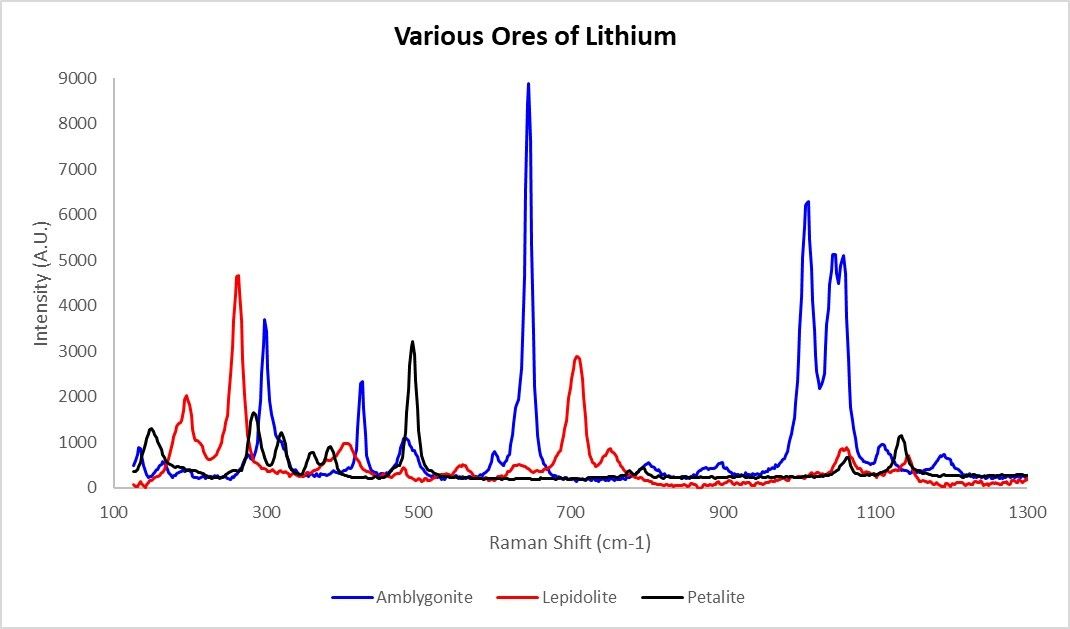
Below is the representative Raman spectrum captured using the high-end Raman spectrometer developed by TechnoS Instruments:
Amblygonite
Exhibits strong phosphate vibrational bands near ~700 cm⁻¹ and ~1100 cm⁻¹, consistent with PO₄³⁻ symmetric and antisymmetric stretching modes, 486 cm⁻¹ is attributed to symmetric Al–O–Al stretching, Low-Frequency Region (140–330 cm⁻¹) Features here relate to O–Li–O (or F) bending and Li–O bond vibrations.
Lepidolite
Shows distinct layered silicate lattice vibrations, notably within the 250-350 cm⁻¹ region, along with an additional feature near ~750 cm⁻¹, characteristic of lithium-rich mica structures.
Petalite
Displays diagnostic Li–Al silicate vibrational bands between 350-500 cm⁻¹, corresponding to bending and stretching modes of the aluminosilicate framework. These spectral differences provide clear mineralogical discrimination, enabling rapid identification of lithium ore types.
This spectral clarity demonstrates the ability of TechnoS Raman systems to differentiate lithium minerals with high confidence essential for exploration and processing.
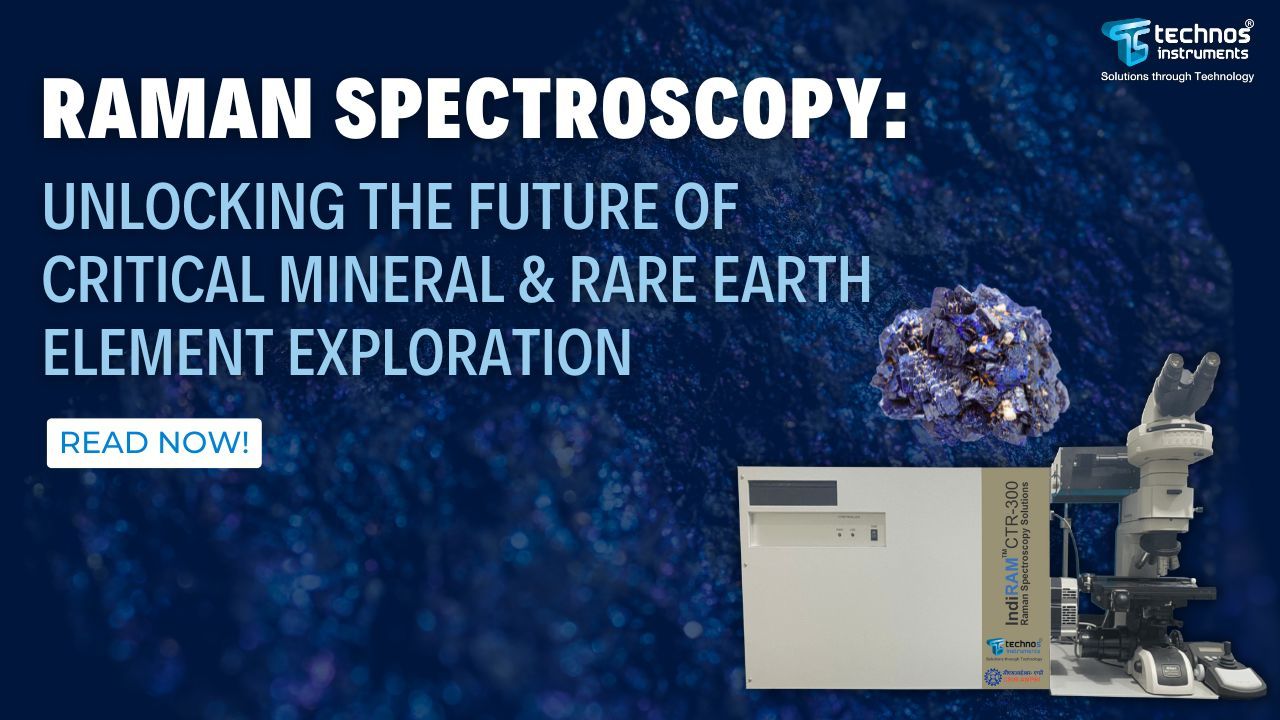
TechnoS Instruments' High-End Raman Spectrometer
Precision Raman Technology Developed in India
TechnoS Instruments has engineered a high-resolution Raman spectrometer optimized for mineral analysis. The system delivers:
- High spectral resolution
- Excellent signal-to-noise ratio
- Stable laser excitation
- Accurate peak reproducibility
High Sensitivity and Resolution for Mineral Fingerprinting
The system is capable of detecting subtle vibrational features, making it suitable for:
Lithium-bearing minerals
- REE-host minerals
- Geological mapping
- Industrial materials characterization
Lithium Detection Capabilities Demonstrated by TechnoS
The lithium ore spectrum shown above is generated using TechnoS instrumentation, providing a real-world demonstration of its analytical performance for critical minerals.
Portable Raman Spectrometer for Field Mineral Detection
Why Field-Ready Raman Matters for Mining and Exploration
Mining teams require immediate verification of minerals directly at:
- Outcrops
- Drilling sites
- Core logging facilities
- Processing plants
A portable Raman solution eliminates delays associated with laboratory testing.
TechnoS Instruments' Ongoing Development of a Portable Raman System
TechnoS Instruments is actively developing a portable Raman spectrometer designed for:
- On-site lithium detection
- Real-time REE mineral identification
- Rapid mineral screening during field campaigns
Real-Time Lithium and REE Detection for On-Site Decision Making
The upcoming portable Raman will enable:
- Faster mapping of high-value zones
- Better resource estimation
- Reduced operational downtime
- More cost-effective exploration workflows
This will be one of India’s first indigenous portable Raman systems tailored for geological and mining use.
Conclusion: Advancing India’s Critical Mineral Capabilities
Raman Spectroscopy as a Strategic Solution for Exploration
Raman spectroscopy offers a powerful, accurate, and non-destructive solution for identifying lithium, rare earth elements, and other critical minerals both in the laboratory and the field.
TechnoS Instruments’ Commitment to Innovation and Mineral Analytics
TechnoS Instruments is committed to supporting India’s scientific and industrial ecosystem with advanced Raman technology, including:
- High-end laboratory Raman spectrometers
- Field-ready portable Raman devices
- Custom Raman solutions for geology, mining, and materials science
With innovation at the core, TechnoS aims to make world-class mineral analysis accessible and affordable across India.