Raman Spectroscopy for Critical Minerals and Rare Earth Elements (REEs) - Copper (Cu)
Raman Spectroscopy for Critical Minerals and Rare Earth Elements (REEs) - Cu
January 2, 2026
Advancing Mineral Detection with TechnoS Instruments
Copper (Cu) is one of the most important industrial and strategic metals, playing a foundational role in electrical infrastructure, renewable energy systems, electric vehicles, power transmission, and electronics. With the global push toward electrification and decarbonization, demand for copper is increasing rapidly, making efficient exploration and mineral identification essential.
Copper occurs in nature in a wide variety of mineral forms, including carbonates, silicates, sulfides and oxides. Accurate identification of copper-bearing minerals is crucial for resource evaluation, beneficiation planning, and geological mapping.
Raman Spectroscopy has emerged as a powerful technique for copper mineral identification due to its ability to probe molecular and lattice vibrations that are highly specific to mineral structure.
Why Raman Spectroscopy for Copper Mineral Identification
Traditional analytical techniques such as XRD and chemical assays provide reliable results but are often time-consuming, sample-destructive and unsuitable for rapid field screening. Raman spectroscopy overcomes these limitations by offering:
Non-destructive, contactless analysis
Rapid mineral identification
High sensitivity to carbonate and silicate structures
Clear differentiation between visually similar copper minerals
Suitability for laboratory and portable, field-based systems.
These advantages make Raman spectroscopy particularly effective for identifying secondary copper minerals formed during supergene enrichment.
Copper Minerals Studied: Dioptase and Malachite
In this study, two structurally distinct copper-bearing minerals were analyses:
- Dioptase – Cu₆Si₆O₁₈·6H₂O - (A hydrated copper cyclosilicate mineral.)
Malachite – Cu₂CO₃ (OH)₂ - (A basic copper carbonate commonly associated with oxidized copper deposits.)
Despite both being green copper minerals, Dioptase and Malachite differ significantly in crystal structure and bonding environment differences that are clearly reflected in their Raman spectra.
Raman Spectral Analysis of Dioptase and Malachite
The Raman spectra were acquired using the TechnoS IndiRAM™ CTR Raman spectrometer, covering the low- to mid-frequency region relevant for silicate and carbonate vibrations.
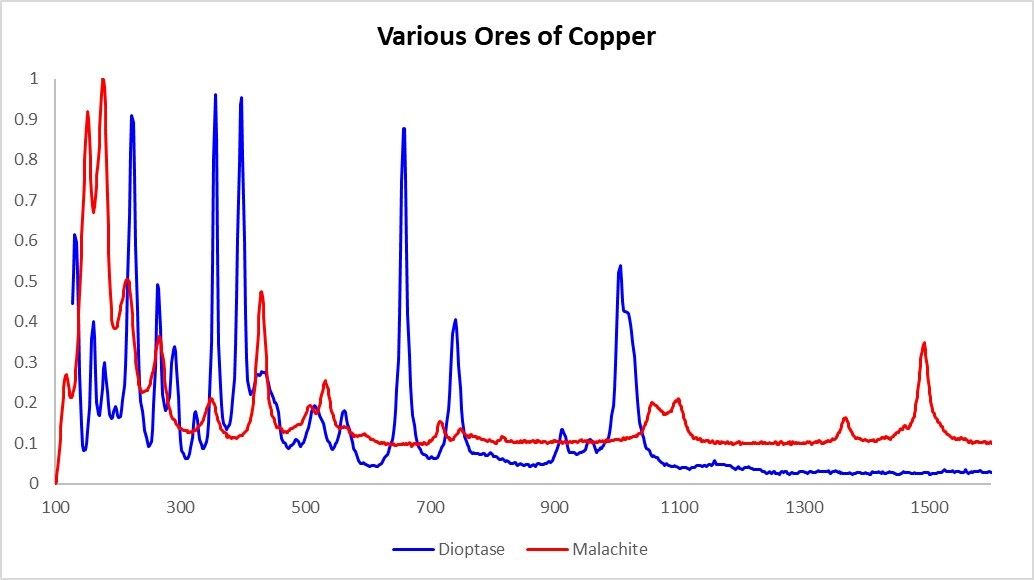
Dioptase (Blue Spectrum)
Dioptase exhibits a complex Raman signature dominated by silicate ring vibrations:
- Cu-O Vibrations: Distinct peaks around 137, 165 and 181 cm⁻¹
- SiO4 Vibrations: Intense bands between 200–500 cm⁻¹ and internal vibrations around 527 and 665 cm⁻¹,
- Si-O Symmetric Stretching: Modes observed around 748, 921, 974 and 1012 cm⁻¹
- Strong bands in the ~350–450 cm⁻¹ region, attributed to Si–O–Si bending modes
- Additional features above ~900 cm⁻¹, related to higher-order Si–O stretching modes
These sharp and intense peaks reflect the well-ordered silicate ring structure of Dioptase.
Malachite (Red Spectrum)
Malachite shows Raman features characteristic of carbonate minerals:
(A). Lattice Modes around 180, 219, 270, 355, 434, 538, 596 cm⁻¹, the band at ~434 cm⁻¹ is particularly intense and characteristic of the Cu-O bending modes.
(B). Carbonate Group Modes:
- Asymmetric bending- A single band around 817-820 cm⁻¹,
- Symmetric stretching- Bands at approximately 1059 and 1097 cm⁻¹ (indicating two different carbonate environments in the structure).
- Asymmetric stretching - Multiple bands are observed, with a main band at ~1490 cm⁻¹ (or 1495 cm⁻¹) and others at around 1368, 1428, and 1462 cm⁻¹.
- Symmetric bending- Bands at approximately 721 and 755 cm⁻¹
The presence of intense carbonate vibrations provides a clear distinction from silicate-based copper minerals.
Key Observations and Mineral Discrimination
Dioptase is clearly identified by its silicate-ring vibrational modes
- Malachite is unambiguously recognized by its carbonate group Raman signatures
The two copper minerals, although visually similar, show distinct and non-overlapping spectral fingerprints
Raman spectroscopy enables rapid, confident discrimination without sample preparation
This demonstrates Raman’s effectiveness for copper mineral identification during exploration and processing.
TechnoS Instruments: Raman Solutions for Copper Exploration
The spectra presented were generated using the high-resolution Raman spectrometer developed by TechnoS Instruments, offering:
- High spectral resolution and stability.
- Excellent signal-to-noise ratio for mineral samples
- Capability to resolve subtle lattice and molecular vibrations
Building on laboratory-grade performance, TechnoS Instruments is actively developing a portable Raman spectrometer aimed at on-site identification of copper, lithium, REE-bearing, and other critical minerals. This field-ready solution will support real-time decision-making in mining and geological exploration.
Conclusion
Raman spectroscopy provides a fast, non-destructive, and highly specific method for identifying copper-bearing minerals. The clear spectral differences between Dioptase (silicate) and Malachite (carbonate) highlight Raman’s strength in distinguishing copper mineral phases with high confidence.
With advanced laboratory systems and ongoing development of Portable Raman solutions, TechnoS Instruments continues to enable efficient, accurate, and accessible mineral analysis supporting the growing demand for critical minerals such as copper in the global energy transition.
Related Articles
- Raman Spectrometer Principle and Core Components
- Gemstone Identification with Raman Spectroscopy
- IndiRAM Raman Spectrometer for identification of Excipients in Pharmaceutical Drugs
- Raman Spectroscopy: A Transformative Tool Across Science, Industry, and Society
- Real-Time Explosive Trace Detection with IndiRAM Raman Spectrometer
- Reinventing Chemical Analysis: How Raman Spectroscopy is Shaping the Future of the Chemical Industry